Friday, 23 September 2011

Seven in Seven - Ruby Day 3

This is the day hat the light is supposed to dawn -unfortunately I was in the pub last night and it feels like midnight in Svalbard on December the 21st. I think I'm also somewhat underwhelmed because Ruby is familiar territory, I did a little bit a few years ago and I've just carried out a project in Python so I'm just left thinking 'and...'

Exercise -extend the RubyCsv class to iterate and return CsvRow objects which you can index via 'method missing'

Again I'm not going  to post the complete code, aside from anything else there's a notice at the top saying that it can't be used in articles. For the iteration I mixed in Enumerable, changed @cvs_contents to an attr_reader and defined the 'each' method :

def each
  @csv_contents.each { |i| yield i }
end

@cvs_contents isn ow an array of CsvRow objects :

class CsvRow
        attr_accessor :contents, :index

        def initialize idx,row
                @contents = []
                @index = idx
                @contents = row.split(', ')
        end

        def method_missing name, *args
                @contents[@index.index(name.to_s)]
        end
end
created thus :

@csv_contents.push(CsvRow.new(headers,row.chomp()))
I don't really like having the header with each object, and their might be a way around this by creating the class on the fly, populating a class variable with the header list, but see the first paragraph.

What have I learned
Mixin is a powerful concept -but not unique to Ruby. method_missing is a powerful idea -and bloody dangerous. I have achieved the same thing in PHP by overriding __call() and I think that was safer.

Ruby syntax is nice, at least you don't have to scatter ':'s everywhere as you do in Python, it's more consistent than PHP and prettier than Perl5 which  generally looks as though a demented spider has been dancing on your keyboard.

Thursday, 22 September 2011

Seven in Seven, Ruby Day 2

Here we're starting to get a little deeper into Ruby, coming across a few nice features, such as code blocks (closures) and mixins. Still not really sure what the fuss is about though.

What did I learn?

Ruby is starting to look quite like python. Duck typing can catch you out : a regex pattern looks like a sting, quacks like a string, but doesn't waddle like a string. Ruby has nicked some of Perls' pattern-matching syntax, which is a good thing as it's great for rule-based input processing.

Exercise : Can we translate a hash to an array, and can we iterate over a hash?


Well, yes we can :

#!/usr/bin/ruby

numbers = {1=>'one', 2=> 'two', 3=>'three', 4 => 'four'}
num_array = []

numbers.each do |num, str|
        num_array.push([num,str])
end
p 'My class is ' + num_array.class.to_s
p 'Element class is ' + num_array[0].class.to_s
puts num_array

 Of course we could have just used numbers.flatten()

#!/usr/bin/ruby
=begin
This exercise is to print the numbers 1 to 16 in groups of 4
=end

#Old school
i = 0
ary = []
(1..16).each do |num|
        if i % 4 ==  0
                if i > 0
                        p ary
                end
                ary = []
        end
        ary.push(num)
        i = i + 1
end
p ary

# One liner -using a code block
(1..16).each_slice(4) {|ary| p ary}

Exercise 3 : Populate the Tree class from a hash.

 I'm not going to put all the code up for this, and I struggled a bit to get it going. The solution that I settled on was to have two classes,  a Tree class that took the hash argument which extended a Node class that was the basic structure.

The Node initializer looks like this :
def initialize(name, node = {})
    @children = []
    @node_name = name
    node.each { |key,child| @children.push(Node.new(key,child)) }
  end

So it just build the tree recursively.

Exercise 4 implement grep

=begin
Grep implementation, matches a string against lines from a file,
outputs the line number and contents of the matched line

usage : rb_grep pattern file
=end

i = 1
File.open(ARGV[1],"r") do |f|
        pattern = Regexp.new(ARGV[0])
        while line =  f.gets 
                line =~ pattern and printf("%d : %s", i,line)
                i = i + 1
        end 
end

Tuesday, 20 September 2011

Seven in Seven : Ruby Day 1.

Here we go, day 1, Bonus challenge -guess a number.

#!/usr/bin/ruby

guess = 1

while guess > 0
        num = rand(10)
        guess = gets.to_i
        if guess > num
                puts "Too high was : " + num.to_s
        elsif guess < num
                puts "Too Low was : " + num.to_s
        else
                puts 'Just Right'
        end
end

Bonus tip, the ruby interpreter is called irb, and doesn't necessarily come with the ruby package.

Monday, 19 September 2011

The Road to Oxiana

by Robert Byron

Byron  was a pre WWII travel writer, indeed he died when his ship was torpedoed in 1941. The Road to Oxiana is the diary of a trip he made to Afghanistan in 1933-4, it can be read on many levels, from 'travelogue of an upper-class brit abroad' to the 'wanderings of an archaeological aesthete'.

One of the main joys of the book is that Byron is always well-written and forthright, for instance on the Venice Lido from the first paragraph :-
 The bathing, on a calm day, must be the worst in Europe: water like hot saliva, cigar-ends floating into one's mouth and shoals of jellyfish.

Lifar came to dinner. Bertie mentioned that all whales have syphilis.
The journey is travelling in the old style, things happen when they will, cars break, rivers flood roads, visas are granted and denied on a whim -his whole trip seems to run several months over its allotted time, and in the end he never does see the Oxus.

Byron's true passion if for architecture -I advise you to cultivate a knowledge of the squinch, it'll be useful for scrabble if nothing else- again the best I can do is to quote, this is about the Friday Mosque in Isfahan :

...But while the larger lacked the experience necessary to its scale the smaller embodies that precious moment between too little and too much,when the elements of construction have been refined of superfluous bulk, yet still withstand the allurements of superfluous grace; so that each element, like the muscles of a trained athlete, performs its function with winged precision, not concealing its effort as over refinement will do, but adjusting it to the highest degree on intellectual meaning.
 All in all it's worth taking the journey with Byron and listening to his story telling on the way. You wouldn't want to be on the sharp end of his tongue though -even if he does dish it out fairly impartially.

Wednesday, 7 September 2011

Haskell - 7 languages in 7 weeks, Day 2

Haskell Day 2 Exercises

Write a Haskell function to convert a string to a number. The string should be in the form of $2,345,678.99 and can possibly have leading zeros.

As I mentioned in the last post, there was a better way to solve this than tail recursion.


strToNum :: String -> Float
strToNum(str) = let num = [x|x <- str,  (x >= '0' && x <= '9') || x == '.']
       in read num :: Float

This function uses list comprehension to filter the string for valid characters and the uses read to convert the filtered string into a floating point number. As you can see it's very concise, and when you are used to the form very readable. This says num is all the valid (0-9 and .) characters from the string str. 

Write a function that takes an argument x and returns a lazy sequence that has every third number, starting with x. Then, write a function that includes every fifth number, beginning with y. Combine these functions through composition to return every eighth number, beginning with x + y.

stepList x n = take 5 [x,x+n..]

threeList x = stepList x 3
fiveList x = stepList x 5

eightList x y = zipWith (+) (threeList x) (fiveList y)


So, the lazy sequence is [x,x+n..] to stop things running off into infinity I've used take to perform the lazy eveluation. Again, Haskell can be very concise -look at zipWith in eightList.


Use a partially applied function to define a function that will return half of a number and another that will append \n to the end of any string.


half = (*) 0.5


This is quite cunning (of Haskell). Inside Hskell all functions are, I believe, curried -that is they take only one argument. As a bit of syntactic sugar Haskell support infix operators, but you can force them to their curried form but surrounding the operator in brackets.  Since the functions are curried they are quite happy to have a dangling second argument, in fact we have here a function that is 'multiply by 0.5'.


backAppend x y = y ++ x
append = backAppend "\n"


The same applies to the append function here, only we have had to define backAppend to get the arguments the way round we want.

I'm going to leave the second set for now, and maybe come back to them at the end.

Tuesday, 6 September 2011

Haskell, where vs let in guards

I'm making a stab at learning Haskell, a functional programming language, and as part of it I'm going through the section in Seven Languages in Seven Weeks, one of the exercises is to convert a string representation of a number to a real (floating point) number, so " $2,345,678.99" to  2345678.99.
Here's my first stab :

import Char

strToNum :: String -> Float

sToN :: (Float, Int, String) -> Float
sToN (acc, dec_place, []) = acc
sToN (acc, dec_place, xs)
        | head xs == '$' = sToN (acc, dec_place, tail xs)
        | head xs == ',' = sToN (acc, dec_place, tail xs)
        | head xs == '.' = sToN (acc, 1, tail xs)
        | dec_place > 0 =
                let  newacc = acc + (fromIntegral (digitToInt (head xs)) )  / (10.0  ^ dec_place)
                in sToN (newacc, dec_place + 1, tail xs)
        | otherwise =
                let newacc = acc * 10.0 + (fromIntegral (digitToInt (head xs)) )
                in sToN (newacc, dec_place, tail xs)

strToNum "" = 0.0
strToNum(xs) = sToN (0.0, 0, xs)

It's a bit brute force and ignorance, but it works. Just thought of a more elegant solution though. The point of this post is the use of 'let' rather than 'where' in the guard expression. The guards (| expressions) handle the various characters and states of the string, and in the two that alter the accumulator define the new value via a 'let'. Initially I tried using a 'where' for this, but it seems that you can only have one per pattern sequence, it would seem that this is because 'let' is a proper expression whilst 'where' is not.

BTW I also tried this with lambdas, but fell foul of the type system.

I quite like this pattern matching approach in general, and have used it in Perl a lot, as it is quite easy to see each 'case' and the logic that goes with it.

Sunday, 14 August 2011

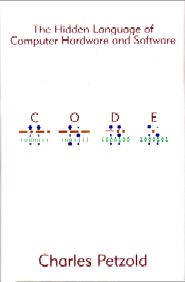
Want to Learn About Computers?

From scratch, then get hold of Charles Petzold's book Code .


Unfortunately Code wasn't written when I was doing wire wraps on breadboards try to build a half adder using bc109s (or what ever transitors we were using) -if it had been the cybernetics weekend I spent as a teenager might have made a whole lot more sense.

Petzold starts right at the beginning with light bulbs and switches, spends a long time with relays and ends up with those classic microprocessors the 8080 and the 6800. If you stick with him, not a hard task, then you will understand how a modern computer works. I haven't quite finished it, but the book is restricted to classic von Neuman machines, I haven't seen any discussion of massively parallel architectures, RISC processors or data-flow engines, never mind quantum computers, but you can go on from here knowing all the basics and with the understanding to tackle more exotic designs.

The book isn't all hardware, it also covers numbering systems, text encoding, machine code and assembler -at the lower end with a brief look at operating systems and languages at the higher end of abstraction.

linkedin