Showing posts with label books. Show all posts

Monday, 19 September 2011

The Road to Oxiana

by Robert Byron

Byron  was a pre WWII travel writer, indeed he died when his ship was torpedoed in 1941. The Road to Oxiana is the diary of a trip he made to Afghanistan in 1933-4, it can be read on many levels, from 'travelogue of an upper-class brit abroad' to the 'wanderings of an archaeological aesthete'.

One of the main joys of the book is that Byron is always well-written and forthright, for instance on the Venice Lido from the first paragraph :-
 The bathing, on a calm day, must be the worst in Europe: water like hot saliva, cigar-ends floating into one's mouth and shoals of jellyfish.

Lifar came to dinner. Bertie mentioned that all whales have syphilis.
The journey is travelling in the old style, things happen when they will, cars break, rivers flood roads, visas are granted and denied on a whim -his whole trip seems to run several months over its allotted time, and in the end he never does see the Oxus.

Byron's true passion if for architecture -I advise you to cultivate a knowledge of the squinch, it'll be useful for scrabble if nothing else- again the best I can do is to quote, this is about the Friday Mosque in Isfahan :

...But while the larger lacked the experience necessary to its scale the smaller embodies that precious moment between too little and too much,when the elements of construction have been refined of superfluous bulk, yet still withstand the allurements of superfluous grace; so that each element, like the muscles of a trained athlete, performs its function with winged precision, not concealing its effort as over refinement will do, but adjusting it to the highest degree on intellectual meaning.
 All in all it's worth taking the journey with Byron and listening to his story telling on the way. You wouldn't want to be on the sharp end of his tongue though -even if he does dish it out fairly impartially.

Sunday, 14 August 2011

Want to Learn About Computers?

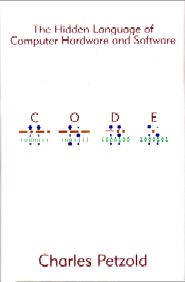
From scratch, then get hold of Charles Petzold's book Code .


Unfortunately Code wasn't written when I was doing wire wraps on breadboards try to build a half adder using bc109s (or what ever transitors we were using) -if it had been the cybernetics weekend I spent as a teenager might have made a whole lot more sense.

Petzold starts right at the beginning with light bulbs and switches, spends a long time with relays and ends up with those classic microprocessors the 8080 and the 6800. If you stick with him, not a hard task, then you will understand how a modern computer works. I haven't quite finished it, but the book is restricted to classic von Neuman machines, I haven't seen any discussion of massively parallel architectures, RISC processors or data-flow engines, never mind quantum computers, but you can go on from here knowing all the basics and with the understanding to tackle more exotic designs.

The book isn't all hardware, it also covers numbering systems, text encoding, machine code and assembler -at the lower end with a brief look at operating systems and languages at the higher end of abstraction.

Wednesday, 9 March 2011

Turing got there first -again.

Alan Turing

I was doing some research into test driven development and came across Tony Hoare's paper  The Emperors Old Clothes . Hoare is a big name in the history of computer science, inventing Quicksort at an early age and then C.S.P -I have had the misfortune to program in Occam (and Ada) which implement this, nothing wrong with the concept or really the language -but Occam simulated on a vintage PC wasn't good.

Hoare's paper is well worth a read, both from a historical perspective and for the all too familiar view of projects going horribly wrong -in this case Algol 68, PL/1 and Ada. Helped by mandated use from the military Ada did finally take off -but so did the Bristol Brabazon - but the language failed to achieve the popularity hoped for and we all ended up using C++ for our sins (which must have been many).

Anyway, back to Turing, it seems he wrote a paper in 1949 (yup) entitled 'Checking a Large Routine' the opening paragraph reads :- 
"How can one check a large routine in the sense of making sure that it’s right? In order that the man who checks may not have too difficult a task, the programmer should make a number of definite assertions which can be checked individually, and from which the correctness of the whole program easily follows"
 Sounds like the basics of Test Driven Development to me.


Tuesday, 15 February 2011

The Blind Watchmaker

by Richard Dawkins


The book that describes the biomorphs. It is much more than that, it aims to explain how a complex world can arise from blind chance and natural selection with no need for an 'Intelligent Designer'. I think that this is an excellent book, whether or not you believe in evolution it explains concepts that are key in several areas. A prime example is complexity and how it can arise from simplicity in small steps. The relationship with probability is explored too -together with some estimates of how likely some out comes, ssuch as life in the universe, are.

Dawkins is a good writer with a clear style who uses good examples to illustrate his points. From bats, to crocodiles; from ants to eyes; he takes examples from across the natural world. Consider the eye, one of the claims of intelligent design is that something as complex as an eye couldn't have arisen from natural selection and an 'incomplete' eye is no good. This is patent rubbish, at some point in evolutionary history there were no eyes and then the ability to tell light from dark evolved -that's a useful thing to have, if you're a worm you don't really need any more than that. In addition there are eyes at different stages of completeness within nature -the nautilus has an eye like ours, but with no lens; our eye is wired up backwards - that of the octopus is wired forwards; the point is that you don't need a perfect eye, just one that is good enough and better than your competitors.

Which reminds me  of the joke about the wildlife film makers who are watching a cheetah when it spots them and puts the team at the head of the menu. As it charges towards them , the sound recordist starts swapping his boots for trainers, when the camera man points out that he still won't be able to out run a cheetah simply because he's wearing Reeboks. 'Mate' replies the recordist, 'I don't have to run fatster than the cheetah -I just have to run faster than you'.

There is lots of other good stuff in here, genetic algorithms, cooperating genes, discussions around Lamarkism and Punctured Equilibrium, genetic explosions and spirals, the tail of the peacock and convergent evolution. All in all very highly recommended.

Sunday, 30 January 2011

Watching the English by Kate Fox

Subtitled 'The Hidden Rules of English Behaviour' this book purports to tell us why we are like we are -if you're English that is, sorry I shouldn't have assumed that. We do apologise a lot, something to do with our social dis-ease and hypocrisy -see, it's true, I wasn't really sorry.

The main fun that comes from the book is compare your own behaviour -and that of your friends, significant others and work colleagues with the behavioral rules laid out in the book. Kate has cunningly played to the English preoccupation with class by giving codes of behaviour for the various classes under each section. The other half lets herself down with a liking for napkin rings and coasters.

She also attempts to put us into context by comparing us to other  nations, for instance picking on our dislike (unless we're from Yorkshire -but the north is another country) of talking about money and our ubiquitous use of humour.

The book is engagingly and amusingly written, but the style can pall and one can get fed up with being called a hypocrite and social autistic, so it is probably best kept as a 'toilet book' -oops 'lavatory book' my lower-middle class slip is showing.

Tuesday, 4 January 2011

The Fabric of Reality

by David Deutsch

This is a frustrating book, I feel that there is some good stuff in there, but that the arguments aren’t that well made.

Deutsch’s theme seems to be that we can construct a theory of everything from four current scientific theories; the Turing Principle of a universal computer, the multiverse version of quantum physics, Karl Popper’s view of knowledge and Dawkin’s update of Darwininan evolution, and the greatest of these is quantum theory. The argument is that all these theories can be related, and that as quantum theory is the most basic -in terms of physics and mathematical description- then it is the most important. The other three theories are emergent, that is they can’t be connected directly, mathematically, to the base theory, in the way that say large parts of chemistry can be, yet they still provide good working explanations of the universe (multiverse!) as it is.

That word explanation is key to the book, he explains (following Popper) that all scientific theories are explanations of problems that we use until we find a better one. I struggled with the word problem, but if I read it more as a conundrum, or define it as something that needs an explanation it helps. An explanation is deemed to be good if it is the simplest one to fit all the known facts, reference William of Occam. So whilst we can describe planetary motion in terms of angels moving heavenly bodies about the earth so as to appear that the earth rotates about the sun, it’s much simpler just to treat the earth as moving around the sun -which we would have to, angels or no- than to worry about the motives of the angels as well.

It is also central to the book that we should treat explanations as serious and true until we find a problem with them that needs a new explanation. So Newtonian mechanics was believed in, and treated as true and the world advanced using Newton for two or three centuries until problems arose (such as the orbit of Mercury being slightly different to that predicted) that required a new explanation. That explanation was General Relativity. Deutsch argues that this is not the case with his chosen theories, although they are the best explanations that we currently have they are not taken seriously, at least in part because we just don’t like them. Quantum theory is downright weird. You either have to believe in the Copenhagen Interpretation that the world changes because you look at it; or the multiverse theory where new universes are created at every decision point, that damn cat is dead and alive. The Selfish Gene is a cold and amoral theory and doesn’t need a god. Not a worry when you’re talking about rocks and atoms, but this is personal and we have emotional problems dealing with it. The Turing principle is fine -but largely ignored, we’re too busy playing with computers to think much about them and perhaps the same is true of Popper, although it seems pretty similar to the scientific method as I was taught it in school.

So what do I think? It’s not very coherent -perhaps because three of the theories are emergent so we can’t formally tie everything together. There are links there between the theories, obvious ones between Turing and Dawkins, and computers are, in a limited sense, quantum devices anyway. So worth reading, lots to think about, but for me it lacked a defined central argument and some of the logic chopping seemed to get close to the ‘All elephants are grey, the battleship is grey, therefore the battleship is an elephant.’; although I do realise that this is because we are supposed to assume the four theories to be absolutely true and dream up ideas around that assumption, ideas that we can then test.

Monday, 6 December 2010

The End of Time

Julian Barbour

I read this book after a discussion about ‘Continuous Creation’ at work -not the Fred Hoyle version, but the older one by (Locke or Hume?). This says that there is no cause and effect, god creates each instant anew and all memories are illusions.

Barbour’s position is similar, except that by getting rid of time he also gets rid of god. If I understand it correctly he proposes that all possible arrangements of everything just are, all at once, in a place he calls Platonia.  There’s a lot of descriptive (no maths), and interesting physics to justify this, which I think I managed to follow pretty well through special relativity until I got lost in Minkowski space. After that I was like a frog looking at a light from a great distance, the occasional photon would hit providing illumination, but it was a flicker or a flash now and then. Did you know that a frog can see individual photons, nor me.

It’s an interesting idea, formulated partly to get around the problem of specifying an initial state that bedevils mainstream physics. If things never start, or evolve then there is no initial state, just a set of configurations and what looks like time, as we experience it, is just a path through some of these configurations.

I think that the book is well worth reading, I like the concepts, the style and the explanations and it has inspired me to read more -and even to start relearning maths at Khan Academy. I’m not wholly convinced by the central idea, I can’t see how consciousness would exist in Platonia -but then I’m still nostalgically attached to cosmic aether.

More at Julian Barbour’s website : http://www.platonia.com/

linkedin